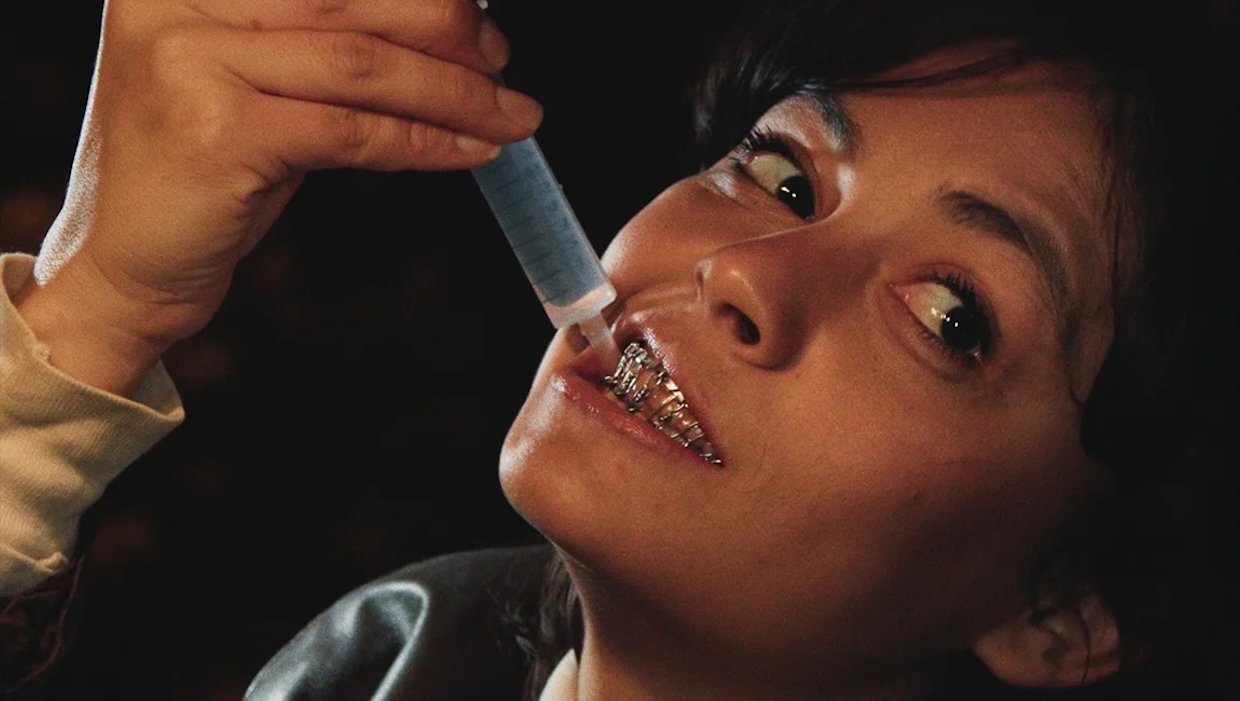
Blu Hunt in Lockjaw
Begun as a scrappy response to the Maryland Film Festival cancelling its edition in 2023, New/Next held its third run in Baltimore from October 2 to 5 and has already announced that the festival will be back next fall. “The word about the festival in the filmmaker community is really strong, especially about the quality of experience we offer them,” festival programmer and co-founder Eric Allen Hatch said during an edition which brought in over 300 filmmakers to The Charles Theater. “I find that most of the works I would want to show are being sent to me.”
“You keep everyone on campus, have them fed, give them water, give them drinks, and people stay to watch another movie and talk between screenings,” festival associate director Emma Hannaway told me. “We want people to go out and explore Baltimore—have a morning or something—but most of your time should be spent here, and that’s what we like.” The entire fest is contained to one city block in the Station North neighborhood, with screenings at The Charles, a filmmaker’s lounge two doors down and opening/closing night parties happening kitty-corner at Metro Gallery. The campus approach seemed to work: the same faces could be seen everywhere on that stretch of Charles Street from noon to well past two am every day.
While a party atmosphere pervades the burgeoning festival, the dance floor at the after-parties has more people huddled talking about the day’s screenings than actually dancing; the energy always wraps back around to the screen. One of the new efforts this year is a student engagement program that brings 40 high school and college students to the fest, showing them the ropes of how to navigate the environment and network with potential colleagues, even giving them a brunch with Albert Birney and Pete Ohs, the director and DP behind the fest’s opening night film OBEX. And the community is active: there were so many Maryland-made shorts at the festival that they constituted four programs on their own. Notably, the only dedicated block for experimental works at the fest was for ones made locally.
The Maryland DIY Shorts felt like an extension of the Baltimore-based screening series New Works, which gets people together a few times a year to show short-form experimental projects or works in progress. Appropriately, New/Next had that series’ co-programmer, local filmmaker Jimmy Joe Roach, introduce these regional works and moderate that Q&A. A highlight selection was Paul Oh’s Jenes Flowers, a predominantly Google Maps-based work examining the falsified small business registrations endemic to the area, with LLCs using fake addresses in residential buildings to create a digital storefront that doesn’t exist in reality, furthering the divide between the world we can find on our phones and the one on the streets. Another short putting a scalpel towards online living, Lincoln Robisch and Sarah Maerten’s Mantis Stream! Like & Subscribe first presents as an impressive “oner” before collapsing into digital fantasia. Mantis Steam! Like & Subscribe has a gag go wrong when the helper starts choking on a “mantis egg” during their usual stream, only to find that the paramedics coming to save him are also streaming and won’t perform a Heimlich until they get ten subscribers. The camera at first pans and dollies, before it starts to perform movements digitally, ultimately becoming a symphony of overlaid and stitched images—both captured and digitally created—as the world (and film itself) deteriorates under the weight of hyper-online social media psychosis.
New/Next is starting to build a coterie of regulars from outside the city, too, perhaps none more than Colin Burgess—at the fest with year one’s surprise hit Dad & Step-Dad, last year with Marissa Goldman’s short 2 Guys and this time around acting in two shorts (Goldwing’s Hookah Head. Brad Roelandt’s one-take surveillance frenzy Aaron and His Dad Try to Find Closure & Lucy Celebrates Andie’s Birthday at Universal CityWalk Hollywood) and two features, Cory Santili’s surreal noirish comedy In the Mouth and Sabrina Greco’s hilarious, increasingly complex debut Lockjaw. Her mouth temporarily wired shut because of a drunk driving accident, Rayna (Blu Hunt) is caught between the affections of her two best guy friends Noah (Kevin Grossman) and Mitch (Burgess), her kind-of boyfriend since her recovery. The trio awkwardly wind up at the house of douchebag mentalist Robert (Nick Corirossi) and his uppity artist wife Cleo (Ally Davis). The comedy builds and builds as characters pair and re-pair inside and outside the house; each time someone enters a room it builds the gag complexity, to the point where the audience might forget that the principle joke comes from Rayna not being able to easily physically communicate, like with how many bits stack on top of each other in Howard Hawks’ Bringing Up Baby that sometimes one forgets that the film’s central conceit is about taking care of a leopard.
Another comedic work full of New/Next regulars, Tucker Bennett’s In the Glow of Darkness, was DP’d by Lockjaw’s Neal Wynne (who also directed last year’s selection The Trick). In the Glow of Darkness takes place in, per the film’s description, “San Zokyo—a 1080p metropolis running at 30 frames per second, 15 minutes into the future and 10 years in the past.” Set in a handmade digital dystopia of gamers, streamers, corporate rulers, and rave-like “meme trippers” who get high by having a QR code on their back scanned, which sends them into a hallucinogenic euphoria that also beams them directly with AI produced targeted ads, it’s a film made with a lot of communal love and underground expertise; for Bennett and his regular collaborators, including Zach Shipko and Chris Corrente, it’s their fifth feature since 2009.
Alex Phillips is following in the footsteps of Baltimore legend John Waters, and not in the usual sense of the particular brand of camp most associated with Waters’ Hollywood turn beginning with Polyester. Phillips’s All Jacked Up and Full of Worms follow-up, Anything That Moves, lives in the free-flowing sexuality and grime of the early Dreamlanders pictures, and beyond its shocking and funny stabs at taboo, finds something similarly liberatory in a community created by people living outside norms. Liam (Hal Baum) is a bike-bound gig worker whose app is a sex work service masquerading as food delivery, and the film opens with a scene of sexual ecstasy: Liam has been hired by his girlfriend, Thea (Jiana Nicole), to go down on her sister who has just turned 18. The bucolic bacchanalia is broken up when their dad bursts into the scene (who we soon find out Liam also gets with). Meanwhile, a serial killer is following close behind Liam, and a bungling cop thinks Liam is the one on the prowl. Phillips’ film is funny, violent, grotesque, sexy and intentionally messy at every opportunity, yet also a celebration of its community-outside-mores, a perfect film to play in the city of Desperate Living.
Such “play well in Baltimore” films have an easy home at New/Next, but they’re not the only thing the fest has to offer. “It seemed like the things that have been really missing from film culture specifically are comedies and particularly rigorous cinema,” Hatch said regarding his programming. One of the more rigorous works this year was David Bim’s To the West, In Zapata, a contemplative documentary following people living on the margins in Cuba’s Zapata Swamp. Part one follows an older man, Landi, as he hunts an alligator. Less an issue doc and more like Lisandro Alonso’s La libertad, Bim lets Landi’s quiet rhythms of rural labor take over the flow, contrasting his seemingly prehistoric routine with radio dispatches of the spreading COVID pandemic, which feels worlds away both in space and time. The film’s most obviously striking sequence is a 13-minute shot of Landi wading through the swamp, capturing an alligator and choking it as it keeps springing back to life. Despite the gorgeous black-and-white photography and extraordinary lulling sequences interrupted by the violence of nature, the most interesting part of Bim’s film is its structural threading—the film’s most breathtaking moment might not be the film’s big “wow” scene, but the point of reunion between Landi and his wife Mercedes towards the tail end of part two, where their segments suddenly collide.
The biggest surprise of the festival, Connor Sen Warnick’s debut Characters Disappearing, is set in New York’s Chinatown in the early 1970s. In gently still 16mm compositions, the film at first unfolds in interiors: a grandmother in her home, a young revolutionary and her boyfriend in their apartment, her spiritually curious cousin learning stories of a 250 year-old sage that their great-grandfather had met in China. When the film moves into the streets, Warnick does not conceal the contemporary shooting of his film, exploring lives flowing in and out of a forgotten left-wing militant movement amongst Manhattan’s Asian diaspora. As Mei (Yuka Murakami) puts up a propaganda poster saying “The East is Red,” modern New Yorkers in masks and streetwear cross the front of the frame. Despite its radical milieu, Warnick’s film draws heavily from the ghostly inhabitations of Tsai Ming-liang and Pedro Costa, often having actors in period costume in fixed portraiture while modern cars move around behind them, as if the time the characters exist in were haunting the present.
Like Jinho Myung’s Softshell last year, Warnick’s Characters Disappearing is the kind of debut that makes New/Next a launching pad for emerging voices in American cinema. Myung is drawing from the contemporary forebears of American DIY filmmaking; Warnick’s cinema springs from access to the contemplative styles of global cinema in the 21st century that are belatedly finding an organic influence in the U.S.. New/Next is a place for all of these to congregate. “It’s sort of a lightning-in-a-bottle moment where we caught something at the right moment, where people wanted a place to show their work and get connected and meet people,” Hannaway told me. “It’s just going with the momentum that’s here.”
New/Next is now a critical cornerstone in the film scene in Baltimore, but the Maryland Film Festival is less than a month away, having moved from the first time away from its historic date at the end of May (though they did host a “Maryland Film Festival Day” celebration then) into early November. However, MdFF already announced that their 27th edition will be held in April of 2026, rather than sticking with the fall long term. While I agree with Hatch in his description of MdFF’s experimental move to November was “quizzical,” it will be interesting to see how Baltimore handles such a saturation of cinema in the city in a year where Next/Next had basically free reign on picks for Maryland premieres of independent films from the entire calendar year. If there is a difference in programming ethos between the festivals, it will soon become apparent.